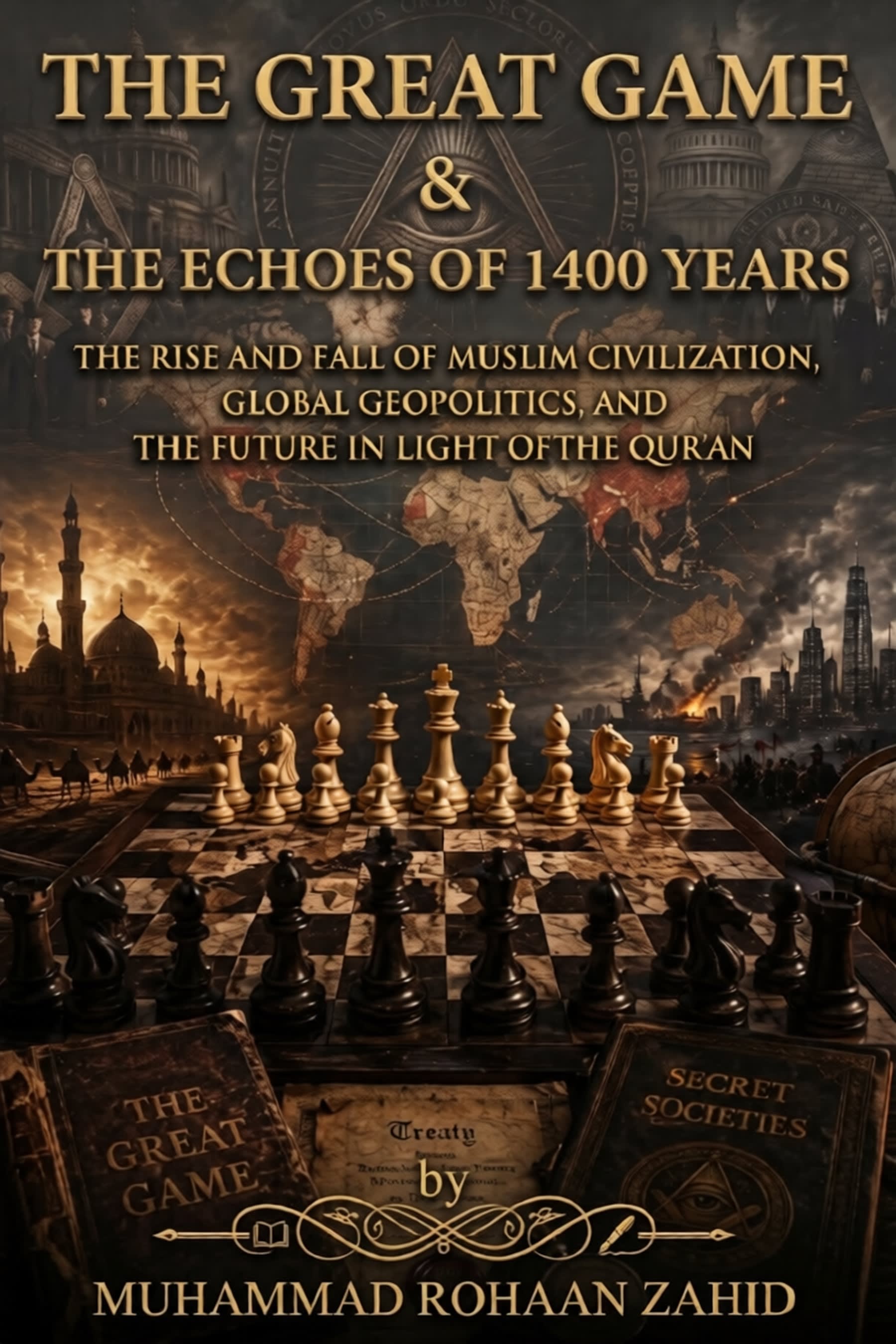
The rise and fall of Muslim civilization, global geopolitics, and the future in the light of the Qur'an.
Muhammad Rohaan Zahid • First Edition • Independently Published • Written in Pakistan
Every civilization asks itself a question when confronted by decline: how did we get here? For nearly two billion Muslims spread across some of the world's most strategically vital territory, that question is more urgent today than at any time in recent history. This book is neither an attempt to romanticize the past nor to condemn the present — it is an attempt to understand the forces that shaped both, combining historical inquiry, geopolitical analysis, and Qur'anic reflection into a single narrative.
Fourteen centuries traced honestly — from the birth of Islam and the Golden Age through colonialism, the Ottoman collapse, and the modern order — without turning history into nostalgia.
Decline is never explained by external aggression alone, nor by hidden actors alone. The book insists on documented facts, reasonable analysis, and honest speculation, clearly labeled as such.
The Qur'an presents history as recognizable patterns, not random events — power as a test, wealth as a test, victory and defeat as tests. Those patterns anchor every chapter.
The Rise and Fall of Muslim Civilization, Global Geopolitics, and the Future in the Light of the Qur'an
By Muhammad Rohaan Zahid — First Edition, written in PakistanEvery civilization asks itself a question when confronted by decline: how did we get here?
There was a time when Muslim scholars led humanity in science, medicine, mathematics, astronomy, philosophy, architecture, and trade. This book asks how the heirs of that Golden Age became spectators in an age they once helped create.
Covering the pre-Islamic collapse, the Qur'anic blueprint for change, intellectual unity, and civilizational fracture.
Covering nation-states, multipolarity, global finance, secret societies, and the dismantling of the Khilafats.
Covering institutional revival, strategic leadership, modern Qur'anic warnings, and the path toward a new dawn.
How a fractured seventh-century world — exhausted by empire, injustice, and superstition — gave rise to a message that would defeat Persia, confront Rome, and build one of history's greatest civilizations.
The internal story: how a civilization that once united power and knowledge began forgetting the legacy of its ancestors, fragmenting politically, and losing the intellectual leadership it had built.
Empires give way to nation-states, a unipolar world gives way to a multipolar one, and new battlegrounds — banking, interest, media, and the creation of Israel — reshape the Muslim world's position on the board.
Secret societies, alleged networks of influence, and the dismantling of the Khilafats — examined with the discipline the book insists on throughout: evidence first, speculation clearly labeled.
What Khilafat actually means in Islamic law and thought, why collective leadership and responsibility matter, and what a renewed Islamic order — including Pakistan's own question of revival — could look like.
Qur'anic warnings for today, read against the present moment, closing with a conclusion aimed not at prediction, but at the principles that could guide genuine renewal.
"Indeed, there has been for you in their stories a lesson for those of understanding."
Surah Yusuf 12:111"Allah knows best where to place His message."
Surah Al-An'am 6:124"Indeed, Allah will not change the condition of a people until they change what is within themselves."
Surah Ar-Ra'd 13:11"And do not be like those who became divided and differed after the clear proofs had come to them."
Surah Aal-i-Imran 3:105"And when We intend to destroy a city, We command its affluent people, but they defiantly disobey therein — so the word comes into effect and We destroy it completely."
Surah Al-Isra 17:16"And be patient. Indeed, Allah is with the patient."
Surah Al-Anfal 8:46History shows that powerful civilizations are rarely defeated from the outside until they have first weakened from within. Yet the Qur'an also directs attention to real, documentable forces — invasion, colonization, and geopolitical manipulation — that accelerated what internal fracture had already begun. This book holds both truths at once, refusing the two traps that make most accounts of Muslim decline incomplete.
Colonialism, foreign intervention, and geopolitical manipulation undeniably shaped the modern world — but external forces alone cannot explain civilizational decline. Division, complacency, political fragmentation, and the gradual loss of intellectual leadership came first.
History certainly contains secret diplomacy, intelligence operations, and competing elite interests. But serious analysis requires evidence and intellectual discipline — this book distinguishes documented fact from reasonable analysis, and reasonable analysis from speculation.
Dynasties, like living things, are born, mature, and inevitably decline — a civilization's decay begins long before its enemies ever arrive at the gate.
Paraphrased from Ibn Khaldun, 14th-century historian & father of the science of civilizational declineWe are a people whom Allah has honored through Islam. Whenever we seek honor in anything else, Allah will humiliate us.
Attributed to Umar ibn al-Khattab, second Caliph of IslamPower is a test. Wealth is a test. Victory is a test. Defeat is a test.
From the Preface of this bookAvailable now through Amazon KDP. The paperback releases worldwide on September 1, 2026 — the e-book edition is coming soon.